
Startup Bookkeeping
Books That Power Decisions, Not Just Reports
Your bookkeeper keeps your books current, accurate, and GAAP-compliant. ClariFi turns reconciled data into 39 KPIs, financial ratios, and automated reporting, with no manual spreadsheet work.
What Your Accountant Delivers
Every month, your bookkeeper handles the work that keeps your financials investor-ready and GAAP-compliant.
Monthly Close
Timely close with reconciliation, accruals, and categorization within 7 to 10 business days of month-end.
Financial Statements
GAAP-compliant P&L, balance sheet, and cash flow statement prepared monthly.
Transaction Categorization
Every transaction coded correctly with consistent chart of accounts.
Bank & Credit Card Reconciliation
All accounts reconciled monthly with discrepancies resolved.
Payroll Coordination
Payroll review, benefits reconciliation, and coordination with Gusto, ADP, or Rippling.
Vendor & AP Management
Payment scheduling, 1099 compliance, and vendor onboarding.
ClariFi Amplifier
Clean Books In, Board-Ready Reports Out
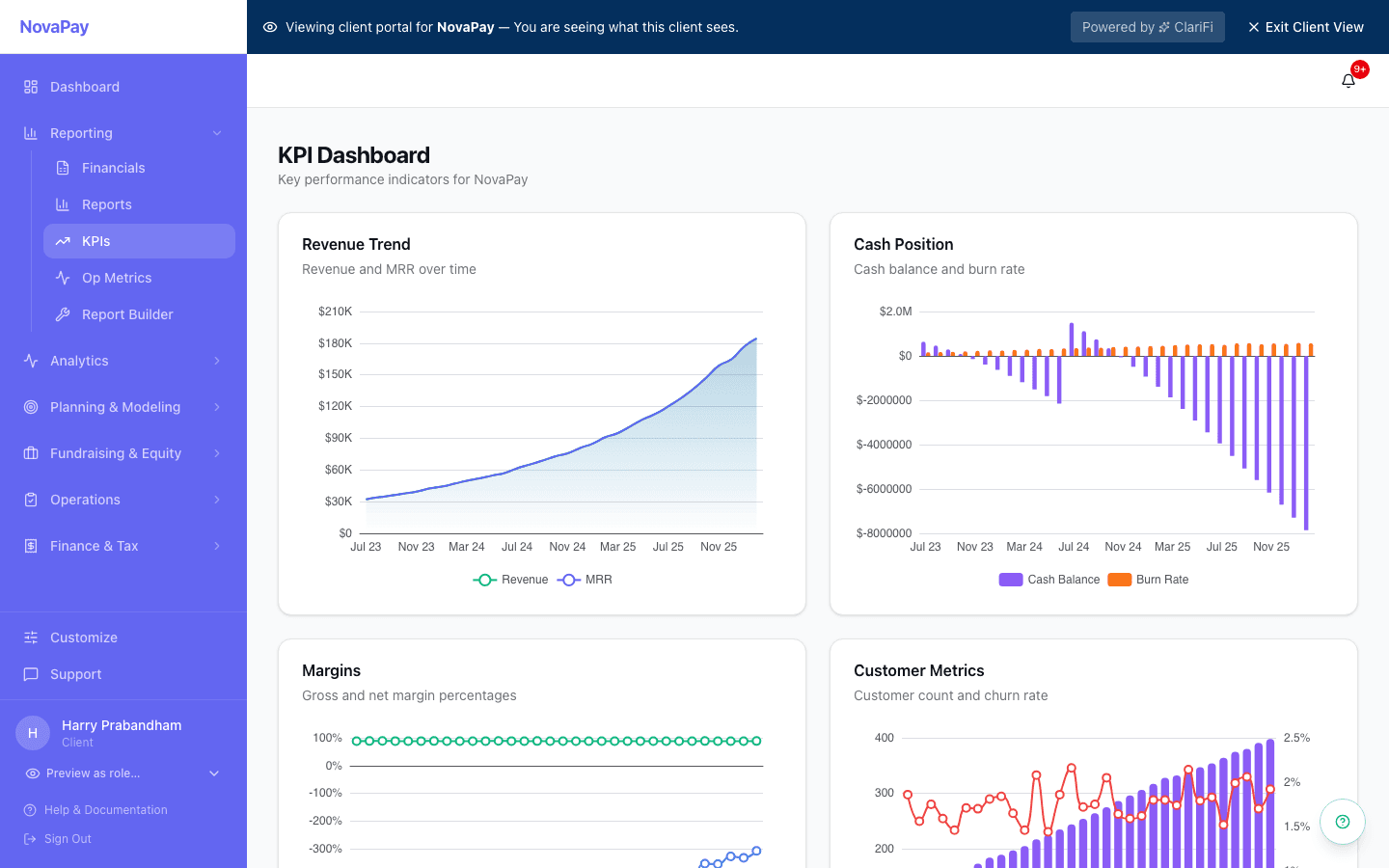
Your bookkeeper's clean books flow directly into ClariFi: 39 KPIs, financial ratios, runway analysis, and board-ready reports generated automatically. No spreadsheets, no manual reporting.
- 39 KPIs across 8 categories, always current
- Automated board packs and investor updates
- Runway and burn rate analysis with proactive alerts
- Industry benchmarking across 14 industries
Why Not DIY or a Basic Bookkeeper?
Every option has trade-offs. Here's how they compare.
DIY Bookkeeping
- Risk of errors with no accountant oversight
- Year-end cleanup costs thousands
- No financial modeling or KPIs
- Backward-looking only
Basic Bookkeeper
- No tax compliance included
- No financial modeling or forecasting
- No KPIs or always-current dashboard
- Separate CPA needed at $2K-$5K/mo
StartupCFO
- Accountant + CPA in every plan, CFO support on higher tiers
- ClariFi-powered KPIs and reporting
- 50% discount on 1 state + 1 federal tax prep
- From $199/mo
Frequently Asked Questions
What’s included in startup bookkeeping?
StartupCFO bookkeeping includes monthly close, bank and credit card reconciliation, GAAP-compliant financial statements (P&L, balance sheet, cash flow), transaction categorization, and payroll coordination. Every plan also includes accountant oversight and tax prep.
How is StartupCFO bookkeeping different from DIY?
With DIY bookkeeping, you risk errors that cost thousands to clean up at year-end. StartupCFO includes accountant oversight from day one to prevent those costs. Plus, ClariFi automatically turns your clean books into 39 KPIs, financial ratios, and board-ready reports, with no spreadsheets required.
What accounting software do you work with?
ClariFi syncs natively with QuickBooks Online, Xero, and Zoho Books, pulls card spend from Ramp, and syncs your cap table from Carta. Your bookkeeper reconciles payments, banking, and payroll systems (Stripe, Mercury, Gusto, and others) into the same ledger, so everything flows into one system.
How quickly can you take over our books?
You can be live on ClariFi within 2 business days of signing up. Full book migration, including reconciliation, chart of accounts cleanup, and KPI setup, typically takes under a week.
Keep learning
GAAP Basics for Startups
Understand the Generally Accepted Accounting Principles that every startup needs to follow, from revenue recognition to accrual accounting.
InsightThe CFO Split Is Already Here for Startups. Most Founders Are Living Inside It.
A Forbes Finance Council piece argues the CFO job has quietly split into an Operator and a Capital Strategist. In startups the split is sharper: the operator job is daily from the first payroll, the strategist job is episodic around a raise, and the founder is usually paying for both inside one hire that cannot do either well.
GlossaryASC 606
GAAP revenue recognition standard for contracts with customers.
GuideHow to Read Your Financial Statements
A founder-friendly guide to understanding your income statement, balance sheet, and cash flow statement, and how they work together.
InsightHow We Run Our Own Finance Practice on AI
Every early-stage startup needs a finance team and almost none can afford one. So we changed how the work runs: tested code does the arithmetic, AI drafts the explanation, and an expert signs every number before it leaves. The software can be duplicated; trust cannot. A 20-minute walkthrough of the practice we run on ourselves.
GlossaryASC 718
GAAP rules for expensing stock-based compensation.
Months behind on your books? Our fixed-price catch-up bookkeeping service gets you reconciled and raise-ready first.
Not ready yet? Everything we teach is free: Guides · Knowledge Base · Free Tools · Templates · Workshops
Ready to Get Your Books Right?
Book a call and your finance team will be live within 2 business days. 45-day free trial · No credit card needed · No contracts.