
For more than thirty years California was the big exception in state sales tax: software was taxable only if it arrived on a physical disk or drive. Download it or run it in a browser and no sales tax applied. That ends on January 1, 2027.
Senate Bill 122, signed by Governor Newsom on June 29, 2026 as part of the 2026-27 budget package, rewrites the definition of "tangible personal property" in California's Sales and Use Tax Law to include "digital products." The term sounds broad, but it mostly means one thing: prewritten software, however it is delivered, including software as a service.
This guide is written for people who are not tax specialists: founders who sell software, finance leads who buy a lot of it, and anyone who has received a vendor email saying California tax is coming to their invoice. It is built from the statute as summarized by the California Department of Tax and Fee Administration (CDTFA), the CDTFA's Special Notice L-1036 and online tax guide, and the draft emergency regulations the CDTFA circulated in September 2026. Where a rule is still in draft form, we say so. The CDTFA is still writing the regulations, forms, and reporting guidance that will make the law workable, so we will update this article as each item is clarified. The modified date at the top shows the last revision.
The change at a glance
| Question | Answer |
|---|---|
| What changed | Prewritten software and SaaS become taxable "digital products" under California sales and use tax |
| Law | Senate Bill 122 (Stats. 2026, ch. 23), a budget trailer bill signed June 29, 2026 |
| Effective | Sales and subscription periods on or after January 1, 2027 |
| Rate | 7.25% statewide plus local district taxes, based on the buyer's address. Combined rates run from 7.25% to more than 10% |
| Who collects | The seller, if it is based in California, otherwise engaged in business here, or exceeds $500,000 in California sales. Otherwise the California buyer self-reports use tax |
| Still taxable? | Software on physical media (always was), downloaded software (new), SaaS (new) |
| Not taxed | Custom software, cloud infrastructure (IaaS and PaaS), streaming video and music, ebooks, video games, digital art, cryptocurrency |
| Exempt even though "digital products" | Services that are mostly human effort, software bought solely for use outside California, software bought with rights to reproduce and resell it |
| Large buyer rule | Once one vendor's sales to one buyer exceed $5 million in a year, the buyer pays use tax directly instead of the vendor collecting |
| Rules status | Statute is final. CDTFA emergency regulations (Reg. 1600 through 1600.3) were in draft as of fall 2026 |
Why California did this
The short answer is revenue. SB 122 was one of the revenue measures in the 2026-27 budget deal. Analyses that cite the Legislative Analyst's Office put the state General Fund gain at roughly $450 million in fiscal 2026-27, which covers only half a year, and about $900 million a year after that. Local governments, who receive a share of every sales tax dollar through the Bradley-Burns local tax and district taxes, are expected to collect roughly $1.1 billion more per year once the tax is fully in effect. Treat those figures as estimates from secondary sources rather than audited numbers.
The longer answer is that California was an outlier. More than twenty states already tax SaaS in some form, including New York, Texas, Pennsylvania, Washington, Massachusetts, and Ohio for business use. Colorado enacted a parallel change (House Bill 26-1223) that also takes effect January 1, 2027. The economy moved from boxed software to subscriptions, and the sales tax base did not follow until now.
Five terms you need to know
SB 122 adds a cluster of new definitions to the Revenue and Taxation Code. Almost every question about the new tax comes down to one of these five.
| Term | What the law says (shortened) | What it means in practice |
|---|---|---|
| Digital product | Prewritten computer software "transferred on tangible storage media, transferred electronically, or accessed remotely" (RTC 6016.1) | Software you buy on a drive, download, or log into. The delivery method no longer matters |
| Prewritten computer software | Software "held or existing for general or repeated sale or lease, even if the prewritten software was initially developed on a custom basis or for in-house use" (RTC 6016.1) | Anything sold to more than one customer. Your SaaS product is prewritten software even if you built it for one client first |
| Accessed remotely | To have accessed, for consideration, prewritten software "that resides on the vendor's server or the server of a third party" (RTC 6016.2) | Logging into software in a browser or app. This is the clause that captures SaaS |
| Custom computer software | Software "prepared to the special order of a single customer," including separately stated charges for custom modifications to prewritten software (RTC 6010.9) | Bespoke software for one client. Not taxed. A modification is custom only "to the extent of the modification" |
| Digital infrastructure | A cloud-based service that lets a user "create, deploy, scale, or run the user's own computer software on the service provider's digital platform" (RTC 6016.1) | IaaS and PaaS. Compute, storage, hosting, and platforms where you run your code. Excluded from the tax |
The CDTFA's draft Regulation 1600 states the SaaS point directly. The definition of digital product "includes, but is not limited to, prewritten software transferred to or accessed remotely by, Software as a Service (SaaS), a computer and other computer applications."
A flowchart for deciding whether a sale is taxable
Most questions about SB 122 can be answered with five yes-or-no questions, asked in order. The chart below walks through them for a single invoice line, then shows who is responsible for the tax once a sale is taxable. The sections that follow explain each step in more detail.
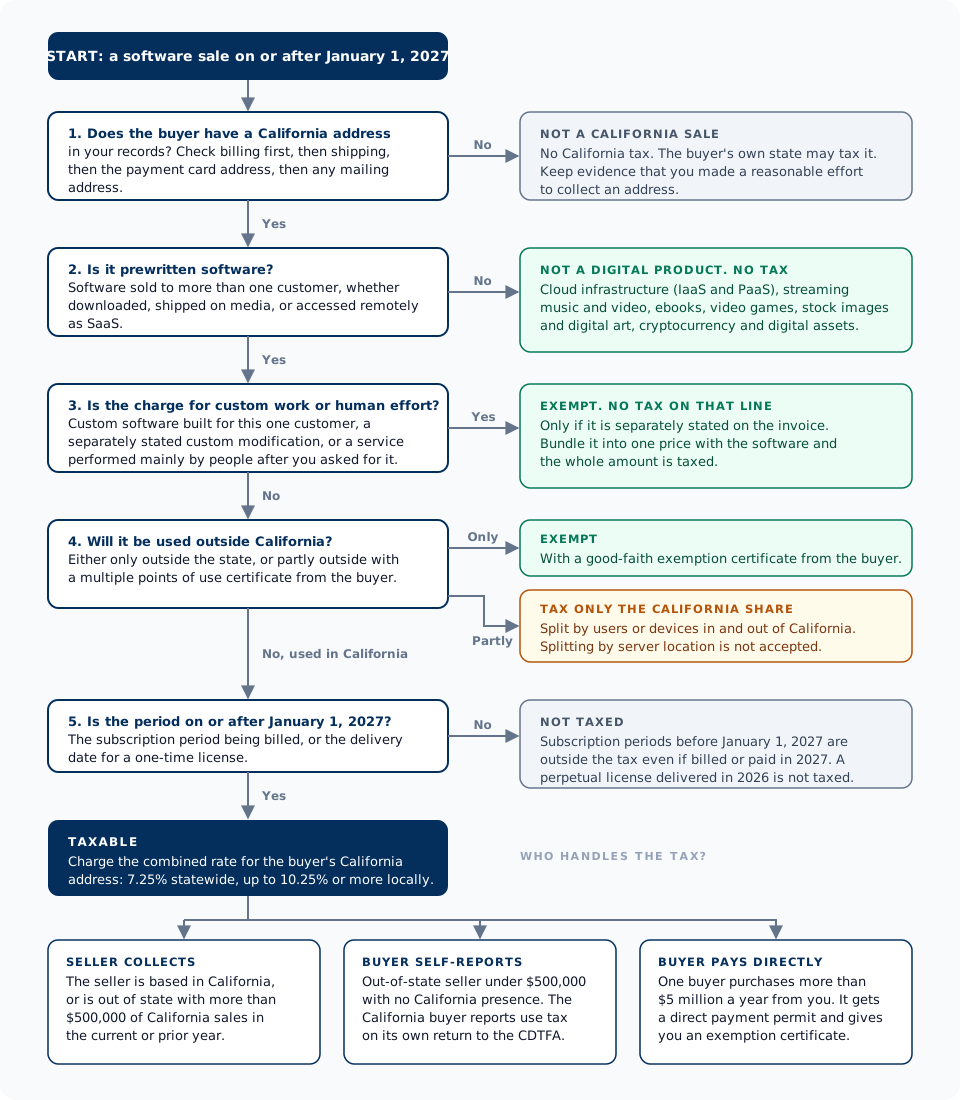
The same five questions in words, with the rule each one comes from:
- Does the buyer have a California address in your records? Check the billing address first, then shipping, then the address on the payment card, then any other mailing address (RTC 6010.5). No California address means no California sale, provided you made a reasonable effort to collect one. The buyer's own state may still tax it.
- Is it prewritten software? Software sold to more than one customer, whether downloaded, shipped on media, or accessed remotely as SaaS (RTC 6016.1 and 6016.2). If what you are selling is cloud infrastructure, streaming media, an ebook, a video game, a stock image, or a digital asset, it is not a digital product and the tax never reaches it.
- Is the charge for custom work or human effort? Custom software built for one customer, a separately stated custom modification, or a service that is mainly people doing work after you asked for it (RTC 6010.9 and 6372.1) is exempt. The statute conditions the modification exemption on separate statement, and in practice the services exemption is lost the same way: bundle either one with the software at one price and the whole amount is taxed.
- Will it be used outside California? Used only outside the state, it is exempt with a good-faith exemption certificate (RTC 6372). Used partly outside, the buyer can give a multiple points of use certificate and you tax only the California share, split by users or devices (draft Regulation 1600.2).
- Is the period on or after January 1, 2027? Subscription periods before that date are outside the tax even if billed or paid in 2027, and a perpetual license delivered in 2026 is not taxed (draft Regulation 1600).
If the answer survives all five, the sale is taxable at the combined rate for the buyer's California address. The seller collects if it is based in California or has more than $500,000 of California sales (RTC 6203). A smaller out-of-state seller does not collect, and the California buyer self-reports use tax. A buyer that spends more than $5 million a year with one vendor takes over payment itself under a direct payment permit (RTC 6052 and 6201.55).
What is taxable and what is not
The law works in three layers. First, is the thing a "digital product" at all? Seven categories are carved out of the definition entirely. Second, if it is a digital product, does an exemption apply? Third, if it is taxable, where is the sale sourced and who collects? This section covers the first two layers with examples. The CDTFA has published few examples of its own so far, so where an example below is our reading of the definitions rather than something the CDTFA has said, it is marked as such.
Taxable from January 1, 2027
| What you buy or sell | Taxable? | Why |
|---|---|---|
| SaaS subscription: CRM, design tool, project management, accounting software, HR platform | Yes | Prewritten software accessed remotely. The CDTFA names SaaS explicitly |
| Downloaded software or mobile app with a one-time price | Yes | Prewritten software transferred electronically |
| Software on a USB drive or disk | Yes | Was already taxable before SB 122 |
| Annual license to a prewritten platform, even if configured for you | Yes | Configuration does not make it custom software unless the custom work is separately stated |
| AI assistant or AI feature inside a software subscription | Yes | The CDTFA's draft example says AI outputs that look tailored are still "trained, automated outputs produced by a generalized machine-learning system that is sold or licensed to many customers" |
| API access to a prewritten software platform | Likely yes | The statute's SaaS language covers access "through either a thin client interface, including a web browser, or a program interface." Our reading; not yet addressed by the CDTFA |
| Mandatory maintenance or support bundled into a software license | Yes | Non-optional charges are part of the taxable measure under the draft rules |
| Educational or training games | Likely yes | The draft regulation says a game used for educational or training purposes is not "used for entertainment purposes," so it is not an excluded video game product. Our reading |
| Custom modification to prewritten software billed as one lump sum | Yes, on the whole amount | The CDTFA's Example 4: a $15,000 lump sum for $10,000 of software plus $5,000 of modification is fully taxable unless the modification is separately stated |
Not a digital product at all
These seven categories are excluded from the definition, so the tax never reaches them.
| Category | Examples from the statute and CDTFA | Note |
|---|---|---|
| Digital infrastructure | IaaS and PaaS: cloud platforms "that allow customers to create, deploy, or run their own software application" | Compute, storage, hosting, and developer platforms where you run your own code |
| Digital audio works | Music, audiobooks, spoken recordings, ringtones | Streaming music subscriptions are not taxed |
| Digital audiovisual works | Movies and videos with sound | Video streaming subscriptions are not taxed |
| Digital books | Ebooks | |
| Digital video game products | Downloadable games, in-game purchases, games played "for entertainment purposes" | Educational games are not covered by this exclusion |
| Digital visual works | Computer-generated artwork, graphics, designs | Stock images and digital art, not the software that makes them |
| Digital assets | Cryptocurrency and non-fungible digital assets |
Digital products that are exempt
These are digital products, but SB 122 exempts them.
| Exemption | What the law says | Plain English and examples |
|---|---|---|
| Custom computer software | Tax does not apply to custom software "other than a basic operational program, regardless of the form in which the computer software is transferred" (draft Reg. 1502.2) | An integration built for one company that "cannot be operated by any other companies" is custom. The CDTFA's Example 3: $10,000 of prewritten scheduling software plus a separately stated $5,000 custom route optimizer is taxable only on the $10,000 |
| Services provided in electronic form | Exempt if "the service primarily involves the application of human effort by the service provider" and the effort "originated after the customer requested the service" (RTC 6372.1). Does not apply to the right to use the provider's software | A consultant delivering a report through a portal, a managed service staffed by people, or an outsourced accounting engagement delivered through software. The exemption is about human work, not the login |
| Reproduction and distribution rights | The right "to reproduce or copy a digital product in order for copies of the digital product to be distributed for consideration to third parties" is exempt (RTC 6362.4) | Licensing your software to a reseller or OEM who redistributes it. Not a general resale exemption for ordinary sales |
| Use solely outside California | Digital products "purchased solely for use outside of this state or in interstate or foreign commerce" are exempt if the seller takes a good-faith exemption certificate (RTC 6372) | A California-billed company buying seats only for employees in Texas. Mixed use is allocated, see below |
Gray areas
A few common purchases do not fit neatly into any box yet.
- Payroll, data processing, and information services. The CDTFA is keeping its existing Regulation 1502 for data processing, renaming it "Data Processing," and says processing customer-furnished information into original information remains a nontaxable service. If a vendor's people run your payroll and send you the output, that looks like a service. If you log into payroll software and run it yourself, that looks like SaaS. Many products sit in between and the invoices will decide.
- Bundles. A contract that combines a software subscription with implementation, training, and support is taxable in full unless the nontaxable parts are separately stated. Separately stating custom work and human services on invoices becomes a real tax planning tool for vendors, as the CDTFA's lump-sum example shows.
- Marketplaces and app stores. The CDTFA's guide says marketplace facilitators "may need to register" to collect on digital products sold by marketplace sellers. The mechanics are not spelled out yet.
- Mixed infrastructure and application services. Cloud providers sell both excluded infrastructure and taxable applications, sometimes on one bill. Expect a service-by-service analysis rather than a provider-level answer.
A worked example: one startup's software bill
Consider a ten-person startup with a San Francisco billing address, where the combined rate on the CDTFA's current table is 8.625 percent. Here is a plausible monthly stack and how each line is treated. The classifications of the payroll and consulting lines are our reading of the rules, not CDTFA rulings.
| Monthly item | Cost | Treatment | Tax at 8.625% |
|---|---|---|---|
| Design tool subscription | $150 | Taxable SaaS | $12.94 |
| CRM | $600 | Taxable SaaS | $51.75 |
| Project management tool | $120 | Taxable SaaS | $10.35 |
| Cloud hosting and storage (IaaS) | $2,000 | Excluded digital infrastructure | $0 |
| Payroll service run by the provider's staff | $300 | Likely a nontaxable service | $0 |
| Video streaming for the office | $20 | Excluded audiovisual work | $0 |
| One-time custom integration, separately stated | $1,500 | Exempt custom software | $0 |
| Total | $4,690 | Taxable base: $870 | $75.04 |
That is roughly $900 a year for this company. The same stack billed to a Los Angeles address at 10.25 percent would cost about $89 a month in tax. A company spending $20,000 a month on taxable SaaS in San Francisco adds about $1,725 a month, or around $20,700 a year. The percentage is modest, but SaaS vendors with thin margins and startup buyers with tight budgets will both feel it, and the vendors who get the invoices wrong will feel it most in their first audit.
Contracts that straddle January 1, 2027
This is the question every vendor and buyer is asking right now, and the CDTFA's draft Regulation 1600 answers it with a clear principle and five examples. A subscription is a "continuing sale and purchase." Tax "does not apply to payments received for subscription periods prior to January 1, 2027" and "applies to payments received for subscription periods on or after January 1, 2027." For one-time purchases, the sale happens when the buyer gets the right to use the software, "regardless of when the consideration is satisfied in full."
| CDTFA example (all assume California sale and use) | Taxed? | Plain English |
|---|---|---|
| Buyer pays on December 15, 2026 for a license but cannot access the software until January 1, 2027 | Yes | Prepaying in 2026 does not help if access starts in 2027 |
| Buyer signs on December 15, 2026, pays in 2027, and gets access on January 1, 2027 | Yes | The access date controls, and it is in 2027 |
| Software is delivered and usable on December 15, 2026, but the buyer pays on January 1, 2027 | No | A one-time sale completed in 2026 is not taxed just because the invoice is paid later |
| Monthly subscription with a 12-month commitment signed December 15, 2026, at $15.99 for three months then $29.99 | Split | The 2026 portion is untaxed. Every month from January 2027 onward is taxed |
| Software delivered December 15, 2026, with a choice to pay $300 up front or $29.99 a month for twelve months | No | A one-time sale in 2026, financed over time, is still a 2026 sale |
The practical rules that fall out of this:
- Annual prepaid subscriptions that started in 2026 and run into 2027 will, under the draft, owe tax on the 2027 portion. Expect vendors to either invoice the tax separately in January or to absorb it. Watch for both.
- Perpetual licenses delivered in 2026 are the one clean way to buy software untaxed before the deadline. True perpetual licenses are rare in modern SaaS.
- Renewals that begin on or after January 1, 2027 are fully taxed, whatever the original contract date.
- Multi-year deals signed before the law should be reviewed for who bears new taxes. Many enterprise contracts say the customer pays applicable taxes, which means a 2025 contract can carry a 2027 tax.
When the seller and the buyer are in different places
California, like every state, has two parallel taxes. Sales tax is owed by a seller on sales made in California. Use tax is owed by a buyer who uses property in California when sales tax was not paid, and sellers who are "engaged in business" in California must collect it. The rate is the same. The difference is who is on the hook, and SB 122 adds a set of sourcing rules written for products that have no physical location.
The core rule for remote sales is in new RTC 6010.5. If the sale is not made in person at a seller's California location, the place of sale is "the purchaser's known address in this state shown in the seller's records." If the buyer gave more than one address, the order of priority is billing address, then shipping or delivery address, then the mailing address on the payment instrument, then any other mailing address. If the seller has no California address for the buyer at all, the sale "shall be deemed to be outside of this state."
A separate rule, RTC 6010.5.1, governs the place of use: "the right or power to remotely access a digital product is exercised at the place where the person accessing the digital product is located." And a presumption applies: software bought outside California and used in California within 90 days is presumed to have been bought for use here.
Here is how those rules play out in the four combinations.
| Seller | Buyer | California tax? | Who handles it | Notes |
|---|---|---|---|---|
| In California | In California | Yes | Seller collects. Sales tax if a California office of the seller genuinely participated in the sale, otherwise use tax collected by the seller | The district rate follows the buyer's address, not the seller's. A San Jose vendor selling to an Irvine customer charges Irvine's 7.75%, not San Jose's 10% |
| In California | Outside California, no California address | No | Nobody, in California | Deemed an out-of-state sale. The seller is protected if it "made a reasonable effort to obtain accurate and complete address information." The buyer's own state may tax it |
| Outside California | In California | Yes | Seller collects if it exceeds $500,000 in California sales in the current or prior year, or is otherwise engaged in business here. If not, the buyer self-reports use tax | The $500,000 threshold is RTC 6203, the economic nexus rule California adopted after the Wayfair decision |
| Outside California | Outside California | No | Nobody | Unless the buyer brings the software into California within 90 days, which triggers the presumption of California use |
Three situations deserve more detail because they describe most startups.
A California SaaS company with customers in many states. You charge California tax only on sales sourced to a California address. For everyone else, you look at their state. New York, Texas, Pennsylvania, Washington, Massachusetts, Ohio (for business use), Connecticut (at a reduced rate), and from 2027 Colorado, all tax SaaS in some form, each with its own nexus threshold and rate. SB 122 does not change your obligations in those states, but it does remove the most common excuse for not having a sales tax engine at all. If you were not collecting anywhere, you now have to build the capability for your home state, and the marginal cost of adding the others is small.
A California startup with a remote team. Your billing address is in California, but a third of your seats are used by people in Austin and Denver. The draft Regulation 1600.2 lets a buyer that knows at purchase that software "will be available for multiple points of use" give the seller a multiple points of use certificate and pay California tax only on the California share. Any "reasonable method that is consistent and uniform" is allowed, and allocating by "the number of users or computers inside this State and outside this State" is presumed reasonable. Allocating by server location "is not considered reasonable." The buyer keeps the records that support the split. Sellers who take the certificate in good faith are protected on the out-of-state portion.
An out-of-state SaaS vendor that is small in California. If your California sales are below $500,000, counting sales by related companies under common ownership, and you have no office, employees, or other physical presence here, you are not required to register or collect. Your California customers owe use tax on your invoices and are supposed to report it themselves. Larger customers with seller's permits do this on their regular returns. Many smaller buyers do not, and the CDTFA's audit focus in the first years of a new tax is usually on sellers, so vendors near the threshold should track California revenue carefully.
The $5 million rule for large buyers
SB 122 includes an unusual provision in new RTC 6052 and 6201.55. Once a single vendor's sales of electronically delivered or remotely accessed digital products to a single buyer exceed $5 million in a calendar year (and from 2028, in the current or preceding year), the vendor is relieved of its obligation to collect on further sales to that buyer. The buyer "shall become liable for the use tax" starting with the transaction that crossed the threshold, must obtain a Use Tax Direct Payment Permit, and gives the vendor an exemption certificate so the vendor stops charging tax.
The purpose is to let very large software buyers, who often use software across many states and locations, allocate tax themselves rather than argue with each vendor about sourcing. A buyer that would rather keep the vendor collecting can ask the CDTFA for a waiver, and must then give the vendor a list of all the places of business where it expects to first use the software. The threshold is indexed to the California Consumer Price Index every five years, starting with a calculation due by October 1, 2031. Insurers are excluded from the rule.
For most startups this rule will never apply. It matters if you sell to very large enterprises, because those customers may start sending you direct pay certificates in 2027, and your billing system needs to know what to do with them.
What SaaS vendors should do before January 1
Several large SaaS vendors, Canva among them, have already begun notifying customers that California sales tax will appear on invoices from January 2027. If you sell software to California customers, here is the checklist. Dates are our suggestions; the legal deadline is January 1.
| Step | Why | When |
|---|---|---|
| Register with the CDTFA for a seller's permit (California sellers) or a Certificate of Registration-Use Tax (out-of-state sellers above $500,000 in California sales) | You cannot collect tax without an account to remit it to. Registration is free through CDTFA Online Services | November 2026 |
| Decide which products and SKUs are taxable, excluded, or exempt | The classification drives every invoice. Infrastructure, human services, and custom work need their own line items | November 2026 |
| Separate your invoices | Custom modifications, implementation, training, and human-delivered services are nontaxable only if separately stated. A single lump sum is taxed in full | Before the first 2027 invoice |
| Configure a sales tax engine or your billing platform for California rates by customer address | Rates range from 7.25% to over 10% depending on the buyer's address, and the address hierarchy (billing, then shipping, then payment, then mailing) must be followed | December 2026 |
| Clean up customer address data | A sale with no California address is deemed out of state. A sale with a stale or wrong address is an audit exposure either way | December 2026 |
| Review contract terms for who bears taxes, and update pricing pages to say "plus applicable taxes" | Multi-year contracts signed before SB 122 may be silent or may put the tax on the vendor | December 2026 |
| Build a process for exemption, multiple points of use, resale, and direct pay certificates | Customers will start sending them in January. The CDTFA has not published final forms yet | January 2027 |
| Notify customers | Nobody likes a surprise line on an invoice. Explain the law, the date, and how straddling subscriptions will be handled | December 2026 |
| Set up local and district tax reporting by customer location | The CDTFA says more guidance on reporting local and district use tax "will be provided as it becomes available." Build the data capture now | January 2027 |
Sales tax tools that are ready for California
Nobody should calculate district rates by hand for every invoice. The tools below handle rate lookup by address, product tax codes, exemption certificates, and in most cases registration and filing. "Ready" here means the vendor has published guidance saying its engine will treat California prewritten software and SaaS as taxable from January 1, 2027. We checked each vendor's public pages on November 9, 2026. We have no affiliation with any of them and receive nothing for listing them; the list is alphabetical.
| Tool | What it is | California 2027 status | Typical fit |
|---|---|---|---|
| Anrok | Sales tax engine built for software companies. Calculation, registration, filing, exemption certificates. Integrates with Stripe, Chargebee, QuickBooks, NetSuite | Published a help-center article on California SaaS tax effective 2027, a prep checklist, and templates for notifying customers | Venture-backed SaaS from seed through late stage |
| Avalara AvaTax | Broad tax engine for every industry with a large integration library and ERP connectors | Published a California SB 122 compliance page and says digital software sales count toward the $500,000 threshold from January 1, 2027 | Companies that also sell physical goods, or run NetSuite or another ERP |
| Numeral | Managed sales tax for startups: registration, filing, and remittance handled by the vendor. Integrates with Stripe, Shopify, QuickBooks | Published an SB 122 guide, including the $5 million large-buyer rule | Small finance teams that want the work done rather than a tool to operate |
| Paddle | Merchant of record. Paddle becomes the legal seller of your product and the tax is its liability | Paddle's platform page says tax liability rests with Paddle. Its older blog still describes California SaaS as exempt, so ask it to confirm the January 1 switch in writing | Self-serve products sold by card, in exchange for a percentage of revenue. Does not cover invoices you send outside Paddle |
| Stripe Tax | Built into Stripe Billing and Checkout. Calculation plus filing through TaxJar, which Stripe owns | Stripe's state guide lists California SaaS as taxable from 2027. Confirm each product is mapped to a software tax code rather than a general one | Startups already billing on Stripe |
| TaxCloud | Lower-cost engine with filing, strongest in ecommerce | Published a 2027 guide to California tax on prewritten and electronically delivered software | Price-sensitive teams, especially those selling downloads |
| Zamp | Managed sales tax with monitoring, registration, and filing | Says its customers need to take no action because the affected tax codes are already mapped and the treatment switches on January 1 | Small and mid-size companies that want a managed service |
Kintsugi, Sphere, Quaderno, Vertex, and Sovos also sell SaaS-capable tax engines. We did not find a published California 2027 notice from them when we checked, which does not mean they are unprepared; ask for written confirmation before you sign. TaxJar, which Stripe owns and which handles calculation, reporting, and filing with SaaS product tax codes, had not published anything on the change either, and its SaaS tax guide dated April 2026 still lists California as not taxing SaaS. If you use TaxJar directly rather than through Stripe Tax, ask it in writing to confirm that its California software codes switch on January 1. Billing platforms such as Chargebee, Recurly, Maxio, and Orb do not calculate tax themselves and connect to one of the engines above. QuickBooks Online's built-in automated sales tax can work for a company that invoices from QuickBooks, as long as the product category for each software item is set correctly.
A tool is not a compliance program. Work with your accounting or CPA team before you turn any of these on. They should decide which products map to which tax codes, how custom work and human services are separately stated, which address field your billing system treats as the place of sale, how contracts that straddle January 1 are split, and which other states your sales have crossed thresholds in. Invoicing correctly matters twice over: it keeps nontaxable items untaxed, and it stops you from creating sales tax nexus and exposure you did not plan for. A tax engine switched on in a state where you are not registered collects tax you cannot remit, and registering everywhere at once creates filing obligations in states where you owe nothing. Get the invoice right first, then automate it.
What software buyers should do
If you are a startup that buys software rather than sells it, your exposure is smaller but not zero.
- Budget for it. Add roughly 8 to 10 percent to the California-sourced share of your software spend from January 2027. Hosting and infrastructure are excluded, so for most engineering-heavy startups the increase is on the business tools, not the cloud bill.
- Check January invoices. Vendors will get the first month wrong in both directions. Watch for tax charged on excluded infrastructure or on 2026 subscription periods, and for taxable SaaS with no tax at all.
- Self-report when a vendor does not collect. If an out-of-state vendor does not charge California tax on taxable software you use in California, you owe use tax. Companies with a seller's permit report it on their sales and use tax return. Others can register for a consumer use tax account with the CDTFA.
- Use multiple points of use certificates if your team is distributed. If half your seats are outside California, you should not be paying California tax on all of them. Document the headcount split and give vendors the certificate.
- Review your own contracts. If you signed a multi-year SaaS deal that says you pay applicable taxes, the 2027 tax is yours. If it is silent, talk to the vendor before January.
- Watch the $5 million rule only if you spend more than $5 million a year with a single software vendor, which almost no startup does.
What is still unsettled
The statute is final, but the rules that make it workable are not. The CDTFA held a public workshop on July 21, 2026, released a discussion paper with draft emergency regulations on September 1, 2026, held an interested parties meeting on September 10, and took written comments through September 24. It said it would proceed with emergency rulemaking, which lets regulations take effect immediately on approval and stay in place for up to two years. As of early November 2026 we have not seen final adopted text, and the CDTFA's own guide says it "will be updated with direct payment and waiver process information as soon as it's available." Items to watch:
- Exemption and multiple points of use certificate forms. The draft describes what a certificate must contain, but the CDTFA has not published forms.
- Local and district tax reporting for remote sales sourced to customer addresses.
- Bundled transactions that mix taxable software with nontaxable services, beyond the lump-sum modification example.
- AI products and APIs. The CDTFA's only AI example concerns custom software. Whether usage-based API access to a model is "accessed remotely" prewritten software has not been addressed directly.
- Marketplace facilitator obligations for app stores and software marketplaces.
- Technology transfer agreements. The CDTFA proposes to amend Regulation 1507 so that prewritten software sold with copyright or patent interests is governed entirely by new Regulation 1600, closing a long-running avenue for excluding intellectual property value from the tax base.
The CDTFA has said it will continue to clarify through an "ongoing industry guide and future rulemaking," so expect the online tax guide to change through 2027. We will update this article as each of the items above is clarified, including final regulation text, certificate forms, and the local reporting rules, and we will note what changed and when. Check the modified date at the top of the page for the last revision.
How this fits your tax calendar
Sales tax joins the list of recurring California filings for software companies, alongside the franchise tax, payroll filings, and local business taxes. Our startup tax deadlines for 2027 and the city guides for San Francisco and Los Angeles cover the rest of the calendar, and the tax compliance calendar tool will generate your filing dates by entity type. If you sell a subscription product, the same invoice discipline that keeps sales tax clean also keeps ASC 606 revenue recognition clean, since both depend on separating software from services and allocating across periods.
StartupCFO tracks sales tax nexus in all fifty states for clients on every plan and handles the registration, classification, and filing work described above as part of our startup tax services. If you sell or buy a lot of software in California, the next eight weeks are the time to get the invoices right.
Sources and references
Primary sources:
- California Department of Tax and Fee Administration, Special Notice L-1036, Sales and Use Tax Applies to Digital Products Beginning January 1, 2027 (September 2026): the definition of digital product, the seven exclusions, the four exemptions, the $5 million threshold rule, place of sale and use, and registration requirements.
- CDTFA, Tax Guide for Retailers and Purchasers of Digital Products, including the Definitions, Retailers, and Purchasers tabs: statutory definitions, the address priority rules, the human-effort exemption, the direct payment permit and waiver process, and the statements that further guidance is pending.
- CDTFA, Discussion Paper: Application of Sales and Use Tax to Digital Products, with the text of proposed Regulations 1502, 1502.2, 1507, 1600, 1600.1, 1600.2, and 1600.3 (prepared for the September 10, 2026 interested parties meeting): the subscription transition rule and its five examples, the custom software and AI examples, the multiple points of use rules, and the summary of each Revenue and Taxation Code section added or amended by SB 122. The meeting agenda is also published.
- CDTFA, Tax Information Bulletin, September 2026 (Publication 388): announcement of the digital products tax.
- Senate Bill 122 (Stats. 2026, ch. 23), bill page at the California Legislative Information site. Revenue and Taxation Code sections cited above (6006, 6009, 6009.5, 6010, 6010.5, 6010.5.1, 6010.9, 6016, 6016.1, 6016.2, 6052, 6054, 6201.55, 6362.4, 6372, 6372.1, 6406, 7051.3) are as summarized in the CDTFA discussion paper.
- Revenue and Taxation Code section 6203: the $500,000 economic nexus threshold for out-of-state retailers.
- CDTFA, California City and County Sales and Use Tax Rates: the 7.25% statewide rate and the city rates used in the examples (San Francisco 8.625%, Los Angeles 10.25%, San Jose 10%, Irvine 7.75%), checked November 9, 2026.
Secondary sources:
- K&L Gates, California Expands Sales and Use Tax to SaaS and Certain Digital Products Starting 1 January 2027 (October 8, 2026): status of the emergency regulations and the technology transfer agreement change.
- Holland & Knight, Coming Attractions: California Previews Rules on SaaS and Digital Products Tax (September 21, 2026): rulemaking timeline and commentary on the draft.
- Venable, California Eyes Sales Tax on SaaS and Digital Software (June 2026): revenue estimates attributed to the Legislative Analyst's Office.
- Vendor guidance used for the compliance tools table, all checked November 9, 2026: Anrok, California sales tax on SaaS (effective 2027); Avalara, California SB 122 software tax; Numeral, California SB 122; Paddle, Tax and compliance; Stripe, Software sales tax for SaaS companies, explained by state; TaxCloud, California will tax SaaS and prewritten software in 2027; Zamp, California and Colorado will tax digital SaaS in 2027. Vendor pages describe their own products; we have not tested the engines.
- Colorado House Bill 26-1223, Colorado General Assembly: Colorado's parallel SaaS tax effective January 1, 2027.
- Worked examples are illustrative and use the CDTFA rate table; they are not client data. Classifications marked as our reading are StartupCFO's interpretation of the statute and draft regulations, not CDTFA rulings. This article is general information, not tax advice for your specific facts.
